
Custom Metal Stair Pans: A Complete Project Guide
If you've ever walked up a set of industrial or commercial stairs and noticed the treads feel solid, quiet, and don't flex under your weight, there's a good chance a metal stair pan is doing the work behind the scenes. Stair pans aren't glamorous. Nobody designs a building around them. But get them wrong — wrong gauge, wrong fit, wrong finish — and you end up with squeaky stairs, failed inspections, or a tread system that wears out years before it should.
This guide walks through what custom metal stair pans actually are, how they're built, when custom makes more sense than stock, and what to think about before you send a project out for fabrication.
What Are Custom Metal Stair Pans?
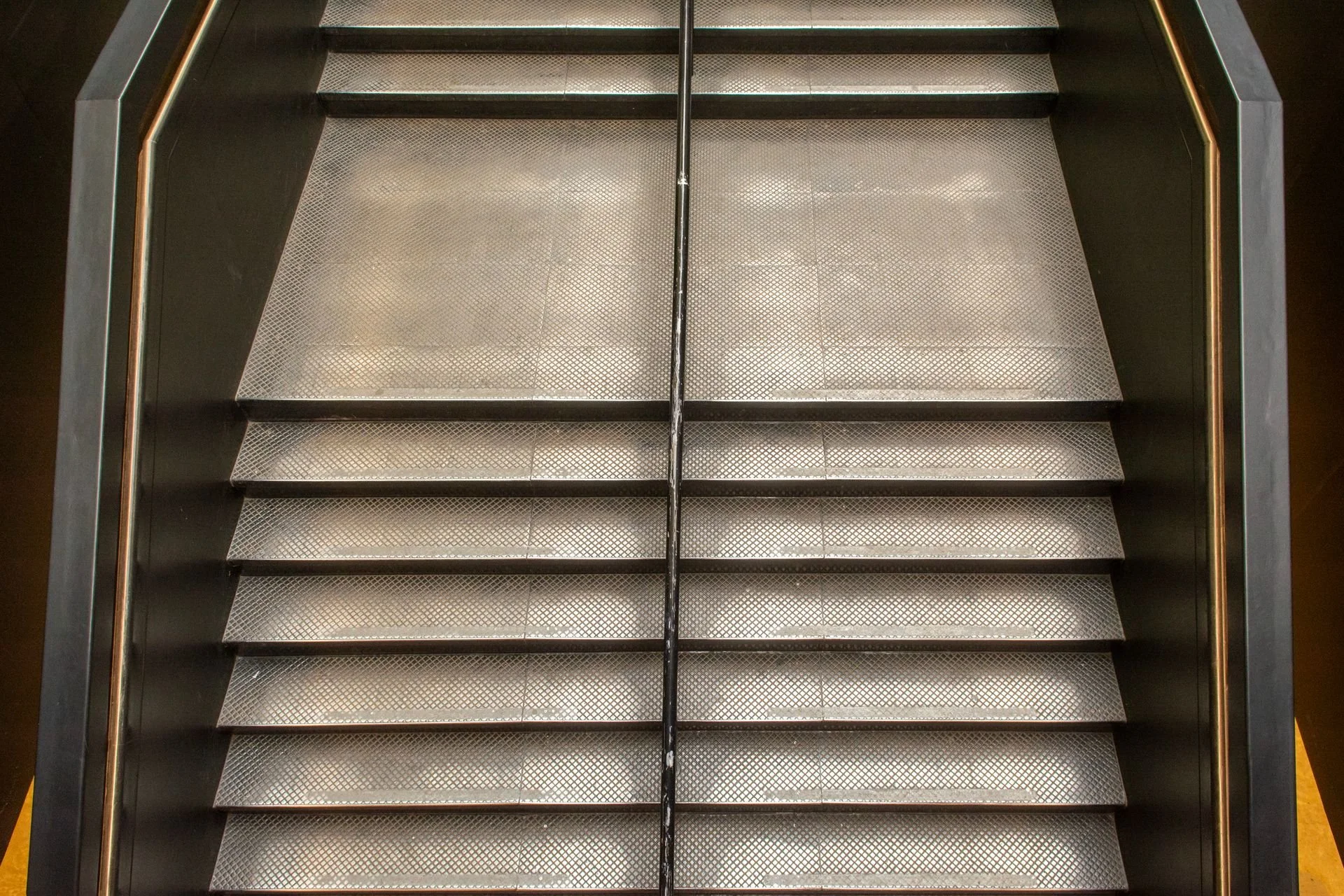
A stair pan is the metal tray or shell that forms the structural base of a stair tread. Instead of pouring concrete directly onto a stringer or bolting down a solid plate, fabricators shape a pan — usually from steel or aluminum — that acts as a form and a load-bearing surface at the same time.
Once the pan is in place, it typically gets filled with concrete, poured terrazzo, or another wear surface. In some applications, the pan itself is the finished tread, with a non-slip coating or abrasive nosing added on top.
Custom stair pans are fabricated to match a specific stair opening, tread depth, riser height, or structural condition — rather than being pulled from a catalog of standard sizes. That matters more than it sounds like it should, because very few real-world staircases are perfectly standard. Existing buildings settle. Retrofit projects have to work around beams, ductwork, or code changes that didn't exist when the original stair was built. New construction sometimes calls for tread depths or stringer spacing that don't match anything sitting on a shelf.
Common materials for stair pans include:
Mild steel — cost-effective, strong, widely used in industrial and commercial settings
Galvanized steel — adds corrosion resistance for exterior or high-moisture environments
Stainless steel — used where corrosion resistance, cleanability, or appearance matter (food processing, healthcare, coastal buildings)
Aluminum — lighter weight, naturally corrosion-resistant, common in exterior fire escapes and platforms
The right material choice depends on load requirements, exposure conditions, and what the finished tread surface will be.
How Metal Stair Pans Work
A stair pan is essentially a formed sheet metal shape — typically brake-pressed or bent to create a shallow tray with upturned edges (called "returns" or "lips") on the front and sides. The pan sits on the stringer or supporting angle iron and carries the load of whatever fills it.
Here's the general sequence:
The stringer or support structure is installed — this is the diagonal beam or angle that carries the stair load down to the floor or foundation.
Pans are set into place on the stringers, usually welded or bolted at specific points.
The fill material goes in — concrete is the most common, though epoxy terrazzo, poured resin, or other toppings are used depending on the application.
A finish surface is applied, which might be broom-finished concrete, a non-slip coating, abrasive nosing strips, or a decorative terrazzo topping.
The pan itself isn't usually the finished walking surface — it's the structural shell that holds everything else together. That's an important distinction, because it means the pan has to be dimensionally accurate. If the depth is off by even a small amount, the finished tread thickness changes, and that can throw off riser heights across an entire flight of stairs — which is a code compliance problem, not just a cosmetic one.
Why Gauge and Bend Radius Matter
Thinner gauge steel is cheaper and easier to form, but it flexes more under load and is more prone to oil-canning (that subtle rippling you sometimes see in sheet metal). Thicker gauge holds its shape better but costs more and is harder to bend precisely, especially on tight radii.
A fabricator who's done this before will size the gauge to the actual expected load — foot traffic only, versus a stair that also needs to handle equipment carts or forklifts — rather than defaulting to whatever's cheapest or whatever's sitting in inventory.
Types of Metal Stair Pans (Standard vs. Custom)
Most fabricators offer some version of "standard" pans built to common tread depths (typically 11" or 12") and standard widths. These work fine when:
You're doing new construction with standard stair dimensions
The project follows a common building code stair configuration
Budget and timeline are tight, and stock sizing happens to fit
Custom pans come into play when:
You're retrofitting an older building with non-standard stringer spacing
Tread depth or riser height needs to match an existing condition
The stair has an unusual width, angle, or landing configuration
Corrosion resistance, load rating, or finish requirements fall outside what's typically stocked
You need returns, nosings, or reinforcement in a specific configuration for a particular application
| Factor | Standard Pans | Custom Pans |
|---|---|---|
| Lead time | Often faster if in stock | Depends on fabrication schedule |
| Cost per unit | Lower | Higher, but avoids field modification costs |
| Fit accuracy | Good for standard stairs | Matched to exact field dimensions |
| Material options | Limited to stocked gauges/finishes | Specified to project needs |
| Best for | New builds, standard code stairs | Retrofits, unusual geometry, industrial specs |
A common misconception is that custom automatically means "expensive" and standard automatically means "cheap." That's not always true. If a standard pan needs to be cut down, re-notched, and reinforced on-site to fit an odd stringer spacing, the labor to modify it can easily exceed the cost of having it built correctly the first time. Field modifications also introduce more room for error — and once concrete is poured, mistakes are a lot harder to fix.
Free Custom Metal Stair Pan Ideas for Your Project
If you're still working out what your stair system needs to look like, here are some practical configurations worth considering, depending on the application:
Closed-riser pans with formed returns — cleaner look, better for public-facing commercial stairs, and helps contain concrete fill during pour
Diamond plate nosing inserts — added grip at the leading edge of the tread, useful in industrial settings where footwear may be wet or oily
Perforated or grated pans — allow water, debris, or light to pass through, common on exterior fire escapes and mezzanine access stairs
Galvanized pans with drainage notches — for exterior stairs where standing water is a concern
Reinforced pans with additional stiffening ribs — for stairs expected to carry heavier point loads, like equipment carts or hand trucks
Stainless pans with a brushed finish — for food service, pharmaceutical, or healthcare facilities where cleanability and corrosion resistance matter
Pre-notched pans for handrail post penetrations — reduces on-site cutting and keeps welds cleaner around post locations
None of these are exotic. They're mostly a matter of specifying the right combination of material, gauge, and formed features up front, rather than trying to adapt a generic pan after the fact.
Custom Metal Stair Pans vs Off-the-Shelf Options
This is the decision most project managers actually wrestle with: do you spec custom pans, or try to make stock components work?
When Off-the-Shelf Makes Sense
Budget is the primary constraint and the stair is a standard configuration
Timeline is tight and stock inventory is available
The application has no unusual load, corrosion, or dimensional requirements
When Custom Fabrication Makes Sense
The building's stringer spacing, tread depth, or riser height doesn't match standard sizing
The stair needs to meet a specific load rating beyond typical foot traffic
Corrosion resistance or a specific finish is required for the environment
You're replacing existing pans and need an exact dimensional match to avoid disturbing surrounding structure
Code compliance requires uniform riser heights across a flight, and existing conditions are inconsistent
A practical example: a manufacturing facility replacing worn stair pans on an exterior fire escape often finds that the original pans were installed decades ago, before current corrosion-resistance standards or drainage requirements were common. Ordering stock pans in that situation usually means someone still has to modify them on-site to fit the existing stringers — welding, grinding, and touch-up coating that adds labor hours and introduces variability. Specifying custom pans that match the existing stringer spacing and add drainage features solves the problem once, without follow-up fieldwork.
The lowest sticker price isn't always the lowest total cost. Field labor, rework, and inspection delays add up fast, and they're often left out of the initial comparison.
Custom Metal Stair Pan Applications Across Industries
Stair pans show up in more places than people expect. Some common applications:
Industrial and manufacturing facilities Mezzanine access stairs, equipment platforms, and interior stairs connecting production floors often need heavier gauge pans rated for foot traffic plus occasional equipment movement.
Commercial and institutional buildings Office towers, schools, and healthcare facilities typically use closed-riser pans finished with terrazzo, tile, or coated concrete for a clean appearance and code-compliant slip resistance.
Parking structures Exterior stairs in parking garages deal with constant moisture, de-icing salt, and freeze-thaw cycles — galvanized or stainless pans with drainage features hold up better here than mild steel.
Fire escapes and emergency egress stairs Often exterior, often exposed to weather, and subject to strict code requirements for load capacity and slip resistance. Perforated or grated pans are common here to reduce water pooling and ice buildup.
Food and beverage processing Stainless steel pans with washable, corrosion-resistant finishes are standard where sanitation requirements are strict.
Each of these environments puts different demands on material choice, gauge, and finish — which is exactly why a one-size-fits-all stock pan doesn't always hold up as well as something specified for the actual conditions.
How to Order Custom Stair Pans in Ontario
Getting a custom stair pan project from idea to installed product usually goes smoother when a few things are sorted out before fabrication starts:
1. Get Accurate Field Measurements
Stringer spacing, tread depth, riser height, and any obstructions (posts, walls, existing framing) should be measured on-site, not pulled from old drawings that may not reflect current conditions. This is the single biggest source of delay when it turns out later that a dimension was assumed rather than confirmed.
2. Define the Load Requirements
Foot traffic only? Occasional equipment or cart traffic? Point loads from stored materials? This determines gauge, reinforcement, and whether additional stiffening is needed.
3. Choose the Material Based on Environment
Interior, climate-controlled space? Mild steel is usually fine. Exterior, coastal, or high-moisture environment? Galvanized or stainless steel earns its higher cost over the life of the stair.
4. Confirm the Finish System
Will the pan be filled with concrete, terrazzo, or another topping? This affects pan depth and whether additional keying or texture is needed on the pan surface to help the fill material bond properly.
5. Factor in Lead Time
Custom fabrication takes longer than pulling stock off a shelf, but a rushed measurement or spec change mid-fabrication almost always costs more time than building in a realistic schedule up front. Ask your fabricator for a realistic lead time based on current shop capacity, not just the fabrication time alone.
6. Work With a Fabricator Who Can Handle the Full Scope
Cutting, forming, welding, and finishing are all separate skill sets. A shop that handles the full process in-house typically means fewer handoffs, fewer opportunities for miscommunication, and better accountability if something doesn't fit right the first time.
If you're planning a stair pan project — whether it's a single retrofit or a multi-flight industrial installation — getting field dimensions, load requirements, and material specs nailed down early makes the fabrication and installation process considerably smoother.
Frequently Asked Questions
What's the difference between a stair pan and a stair tread?
A stair pan is the metal shell or form that provides structure; the tread is the finished walking surface, which may be poured directly into the pan (like concrete or terrazzo) or attached on top of it. In some designs, a coated or textured metal pan serves as the tread itself.
What gauge of steel is typically used for stair pans?
It depends on the load. Light-duty interior stairs might use 12 to 14 gauge steel, while industrial applications with heavier traffic or equipment loads often call for thicker material. The right gauge should be based on expected load, not just cost.
Can existing stair pans be repaired instead of replaced?
Sometimes, if the damage is limited to surface corrosion or minor deformation. But if the pan has significant rust-through, structural flexing, or dimensional inconsistency, replacement is usually more reliable than patching, especially for code-regulated egress stairs.
How long does custom stair pan fabrication typically take?
Lead times vary based on shop capacity, material availability, and project complexity, but custom orders generally take longer than stock components. Confirming field measurements early helps avoid delays once fabrication begins.
Do stair pans need to be welded or can they be bolted in place?
Both methods are used, depending on the application and load requirements. Welding typically provides a more rigid, permanent connection, while bolting can allow for future adjustment or removal, which matters in some maintenance or retrofit situations.
What material is best for exterior stair pans in Ontario's climate?
Galvanized or stainless steel generally hold up better than mild steel in exterior applications, given exposure to moisture, freeze-thaw cycles, and de-icing salt common in Ontario winters. The added upfront cost usually pays off in reduced corrosion-related maintenance.
Are custom stair pans more expensive than standard ones?
Not always. Standard pans have a lower unit cost, but if they require on-site modification to fit non-standard conditions, the added labor can offset or exceed the cost difference. Custom pans built to exact field dimensions often reduce total project cost when standard sizing doesn't fit cleanly.