
Choosing the Right Metal Fabrication Process for Automotive Parts
If you're sourcing custom automotive parts, the real question usually isn't "fabrication or something else"—it's which fabrication method fits your part, your budget, and your timeline. Automotive components come in a huge range of shapes, tolerances, and volumes, and no single process handles all of them well.
This guide breaks down the metal fabrication methods most commonly used for automotive parts, where each one makes sense, and what typically trips up projects before they even reach the shop floor.
What Custom Metal Fabrication Actually Involves
Metal fabrication covers a group of processes used to cut, shape, bend, and join metal into a finished part. For automotive applications, that usually means:
Cutting flat stock to shape (laser, plasma, waterjet)
Bending or forming that stock into 3D geometry (press brake)
Machining features like holes, threads, and precision surfaces (CNC)
Joining pieces together (MIG, TIG, or spot welding)
Finishing (deburring, grinding, coating, powder coating)
Most automotive parts—brackets, mounts, panels, chassis components, exhaust hangers, custom enclosures—go through several of these steps before they're done. The fabricator's job is choosing the right combination for the part in front of them, not just running everything through the same process because it's what's available.

Common Fabrication Methods Used in Automotive Manufacturing
Laser Cutting
Laser cutting uses a focused beam to cut through sheet metal with very tight tolerances and clean edges. It's the go-to method for flat parts with intricate profiles—brackets with multiple mounting holes, panels with cutouts, or parts that need repeatable accuracy across a production run.
Strengths:
Excellent precision (often within a few thousandths of an inch)
Clean cut edges with minimal burr
Handles complex shapes without extra tooling costs
Efficient for both prototypes and mid-to-high volume runs
Limitations:
Works best on flat stock; not suited to thick plate without slowing down significantly
Highly reflective materials (like polished aluminum or copper) can require special settings
Not cost-effective for very simple, low-precision cuts on thick material
Plasma Cutting
Plasma cutting uses an ionized gas jet to cut through electrically conductive metal. It's faster and cheaper than laser cutting on thicker material, though it sacrifices some precision.
Strengths:
Cuts thick steel and aluminum quickly
Lower equipment and operating cost than laser
Good option for structural components where tight tolerances aren't critical
Limitations:
Wider kerf (cut width) and rougher edge than laser
Less accurate on fine detail or thin gauge material
Usually needs secondary finishing on edges
CNC Machining
CNC (computer numerical control) machining removes material from a solid block or pre-cut blank to create precise features—holes, threads, pockets, and tight-tolerance surfaces. This is where automotive parts get the accuracy needed for things like mounting interfaces or components that mate with other machined parts.
Strengths:
Very tight tolerances, often within 0.001"–0.005"
Repeatable across large production runs
Works with almost any machinable metal
Limitations:
Slower and more expensive per part than cutting/forming processes
Best suited to parts that actually need that level of precision—using CNC where it isn't needed just adds cost
Press Brake Forming
Once a flat piece is cut, a press brake bends it into its final shape—an L-bracket, a U-channel, a formed panel. Bend accuracy affects how well the part fits with everything else in the assembly.
Strengths:
Fast, cost-effective way to create 3D shapes from flat stock
Good repeatability with proper tooling
Works across a wide range of material thicknesses
Limitations:
Bend radius and material springback need to be accounted for in the design—this is one of the most common sources of parts that don't fit right the first time
Complex geometries with multiple bends can require multiple setups
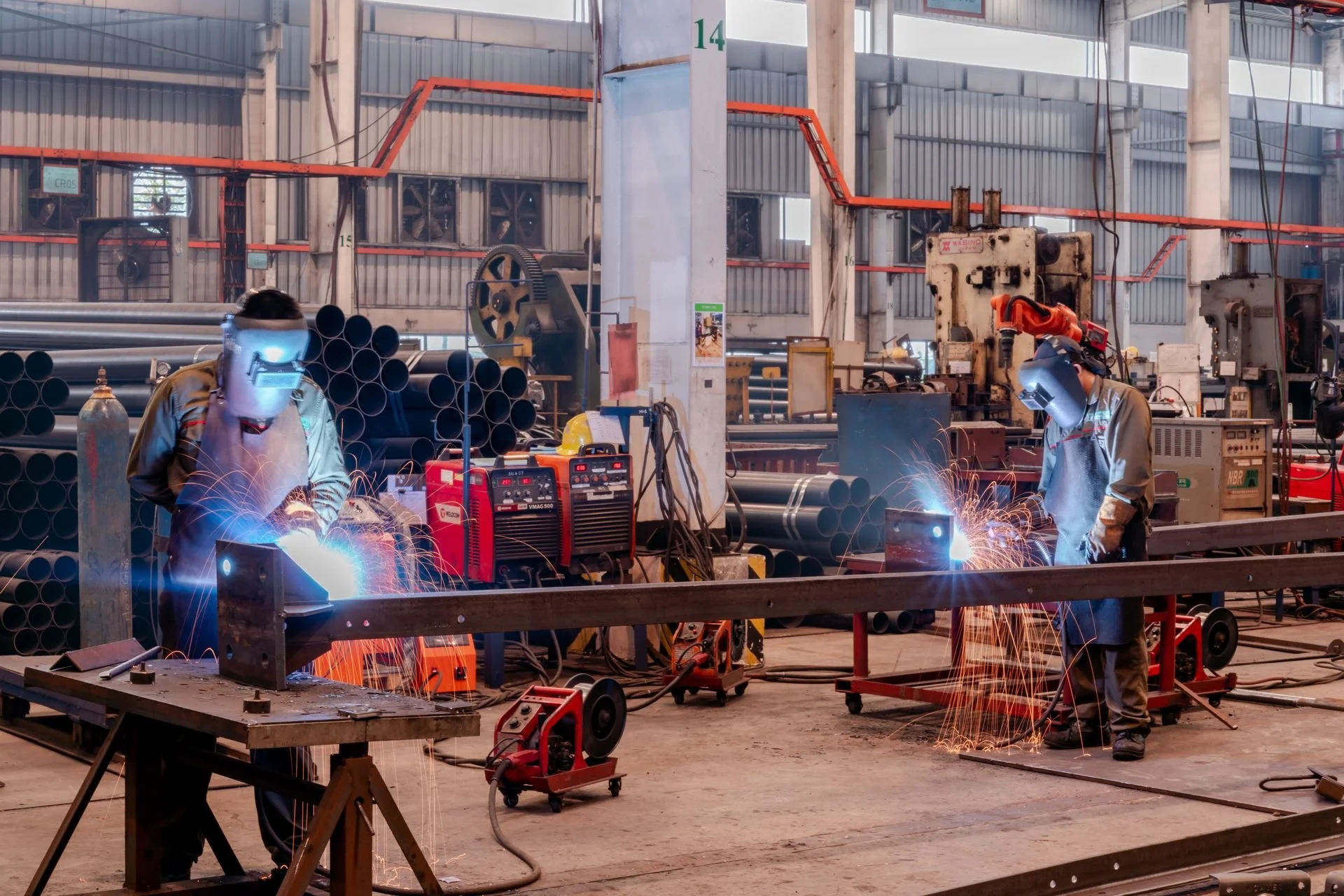
Welding (MIG, TIG, Spot)
Welding joins components into a single structure. Different methods suit different materials and applications:
| Welding Method | Best For | Notes |
|---|---|---|
| MIG | Steel and aluminum, general fabrication | Faster, more forgiving, good for thicker material |
| TIG | Aluminum, stainless, precision joints | Slower but cleaner, better for visible welds and thin material |
| Spot Welding | Sheet metal assemblies, high-volume production | Fast and consistent, but limited to overlapping sheet joints |
Weld quality matters more in automotive applications than people sometimes assume—a weld that looks fine cosmetically can still be a stress concentration point if it wasn't executed with the right heat input and joint prep.
Stamping and Punching
For high-volume runs of the same part, stamping or punching can outperform laser or plasma cutting on cost per unit, since the tooling investment pays off over thousands of parts.
Strengths:
Very low cost per part at high volumes
Fast cycle times
Limitations:
Tooling cost only makes sense above a certain volume threshold
Design changes after tooling is built are expensive
Not practical for prototypes or low-volume custom runs
Comparing Fabrication Methods for Automotive Parts
| Process | Best For | Typical Tolerance | Volume Fit |
|---|---|---|---|
| Laser Cutting | Complex flat profiles, brackets, panels | ±0.005" | Prototype to high volume |
| Plasma Cutting | Thick plate, structural parts | ±0.03"–0.06" | Low to mid volume |
| CNC Machining | Precision features, mating surfaces | ±0.001"–0.005" | Prototype to mid volume |
| Press Brake Forming | 3D shapes from sheet stock | ±0.01"–0.02" | Prototype to high volume |
| Stamping | Simple, repeated geometry | ±0.005"–0.01" | High volume only |
Material Considerations for Automotive Fabrication
Material choice affects cost, weight, strength, and how a part behaves in the field—which matters a lot in automotive applications where parts deal with vibration, temperature swings, and road exposure.
Mild steel is the default for structural brackets and mounts. It's affordable, easy to weld, and strong enough for most applications, but it needs a coating to resist corrosion.
Stainless steel costs more but holds up better in corrosive environments—exhaust components, fasteners, or anything exposed to road salt and moisture over years of service.
Aluminum cuts weight significantly, which matters for performance applications or anywhere reducing unsprung weight has a real payoff. It's more expensive per pound than steel and requires different welding techniques (typically TIG), but for the right application it's worth the trade-off.
A common misconception is that switching to aluminum is a simple material swap. It usually isn't—wall thickness, weld parameters, and sometimes the whole design need to change to account for aluminum's different strength and thermal properties.
What Actually Causes Delays in Automotive Fabrication Projects
Most delays trace back to a handful of recurring issues:
Incomplete or inconsistent drawings. Missing tolerances, unclear bend directions, or conflicting dimensions send parts back for clarification before cutting even starts.
Material availability. Specialty alloys or specific gauges aren't always sitting on a shelf. Lead times can shift depending on what's in stock versus what needs to be ordered.
Underestimating finishing time. Deburring, grinding, and coating often take longer than the cutting or welding itself, especially on parts with a lot of edges or a cosmetic finish requirement.
Late design changes. A revision after cutting has started, or after tooling is set up for a bend sequence, almost always costs more time than getting the design right up front.
Choosing a process that doesn't match the volume. Requesting CNC machining for a part that would work fine with press brake forming (or vice versa) adds unnecessary cost or misses tolerances the job actually needs.
Design Considerations That Improve Manufacturability
A few habits consistently make fabrication smoother and cheaper:
Design bends with standard radii in mind. Unusual bend radii often require custom tooling.
Avoid tight tolerances where they're not functionally necessary. Every added decimal point of precision adds cost.
Account for material springback in bent parts. A flat pattern that ignores springback will produce a part that's off-angle.
Group similar hole sizes and patterns. This reduces tool changes and setup time.
Talk to the fabricator before finalizing the design, not after. Small adjustments early on—like moving a hole away from a bend line—can prevent costly rework later.
Custom Fabrication vs. Off-the-Shelf Components
Not every automotive part needs to be custom. Off-the-shelf brackets, standard fasteners, and common hardware are cheaper and faster when they fit the application. Custom fabrication earns its cost when:
The part needs to fit a specific vehicle geometry or assembly
Standard components don't meet load, weight, or space requirements
You need a design that's proprietary or performance-specific
Off-the-shelf options exist but don't hold up to the environment (vibration, heat, corrosion)
The trade-off is straightforward: off-the-shelf is faster and cheaper up front, custom fabrication is slower and costs more initially but solves problems generic parts can't.
Working With a Fabrication Partner
Good automotive fabrication projects usually involve back-and-forth between the designer and the fabricator before cutting ever starts. A fabricator who's seen hundreds of similar parts can often spot a manufacturability issue in a drawing that an engineer working outside of production wouldn't catch—things like a bend that's too close to a hole, or a tolerance that's tighter than the process can reliably hit.
That collaboration is where projects save the most time and money. It's a lot cheaper to adjust a drawing than to scrap a batch of parts.
FAQ: Metal Fabrication for Automotive Parts
What's the difference between laser cutting and plasma cutting for automotive parts?
Laser cutting is more precise and produces a cleaner edge, making it better for detailed brackets or parts with tight tolerances. Plasma cutting is faster and more cost-effective on thicker material, but the cut edge is rougher and less precise.
How do I know if my part needs CNC machining or just cutting and forming?
If the part needs precise mating surfaces, threaded holes, or tolerances tighter than about ±0.01", CNC machining is likely necessary. If it's a flat or bent bracket without tight-tolerance features, laser cutting and press brake forming are usually sufficient and more cost-effective.
Is aluminum a good substitute for steel in automotive fabrication?
It can be, but it's not a direct swap. Aluminum is lighter but weaker per unit thickness than steel, so wall thickness and design often need adjustment. It also requires different welding techniques, typically TIG rather than MIG.
What causes the longest delays in custom automotive fabrication projects?
Incomplete drawings, material availability, and late design changes are the most common causes. Getting tolerances, bend directions, and material specs finalized before production starts is the single biggest thing that keeps a project on schedule.
How much does custom metal fabrication cost compared to off-the-shelf parts?
Off-the-shelf components are almost always cheaper up front since there's no design or tooling cost involved. Custom fabrication costs more initially but makes sense when standard parts don't fit the application, don't meet load requirements, or won't hold up in the operating environment.
What tolerances are realistic for automotive fabrication?
Laser cutting typically holds around ±0.005", press brake forming around ±0.01"–0.02", and CNC machining down to ±0.001"–0.005" depending on the feature. Tighter tolerances than a part actually needs add cost without adding value.