
TIG vs MIG Welding: What's the Difference & Which Do You Need?
If you're planning a custom metal fabrication project, chances are the question of TIG vs MIG welding will come up at some point — either from your fabricator or from your own research. Both processes join metal using an electric arc, but they behave very differently on the shop floor, and that difference affects cost, timeline, appearance, and strength.
This guide breaks down how each process actually works, where each one shines, and how to think through the decision for your next project — without the technical jargon overload.
The Quick Answer
MIG welding (Metal Inert Gas) uses a continuous, consumable wire that feeds automatically through the welding gun. It's fast, relatively easy to learn, and well-suited to thicker materials and higher production volumes.
TIG welding (Tungsten Inert Gas) uses a non-consumable tungsten electrode, with the welder manually feeding a separate filler rod by hand. It's slower and more demanding to learn, but it produces cleaner, more precise welds with less heat distortion.
Neither one is "better" across the board. They're built for different jobs, and a good fabricator will pick the process based on the material, the application, and what the finished part actually needs to do.
How MIG Welding Works
MIG welding runs a spool of solid wire through the welding gun. As the trigger is pulled, the wire feeds continuously and melts into the weld pool while a shielding gas — usually a mix of argon and CO2 — protects the molten metal from contamination in the air.
Because the wire feed is automatic, the welder's main job is guiding the gun along the joint at a steady pace. That's part of why MIG is often the process people learn first.
Where MIG works well:
Structural steel and heavier gauge material
Production runs where speed matters
General fabrication — brackets, frames, equipment guards, chutes
Jobs where weld appearance is secondary to strength and speed
MIG welding is the workhorse of most fabrication shops, and for good reason. It's efficient, it handles a wide range of material thicknesses, and it holds up well structurally. This is why at BSG, MIG accounts for the vast majority of welding work — it fits the reality of most custom fabrication and structural steel projects.
How TIG Welding Works
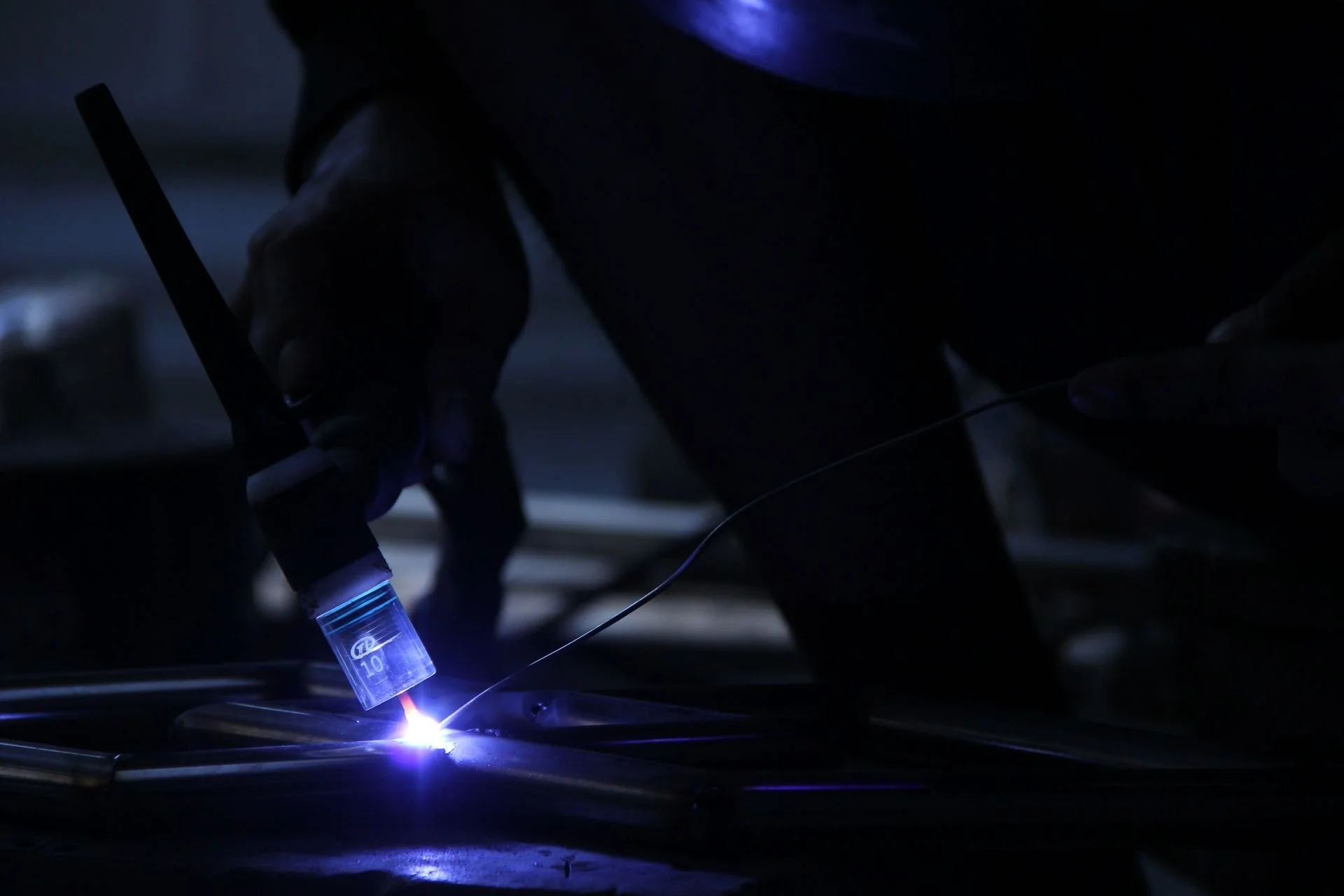
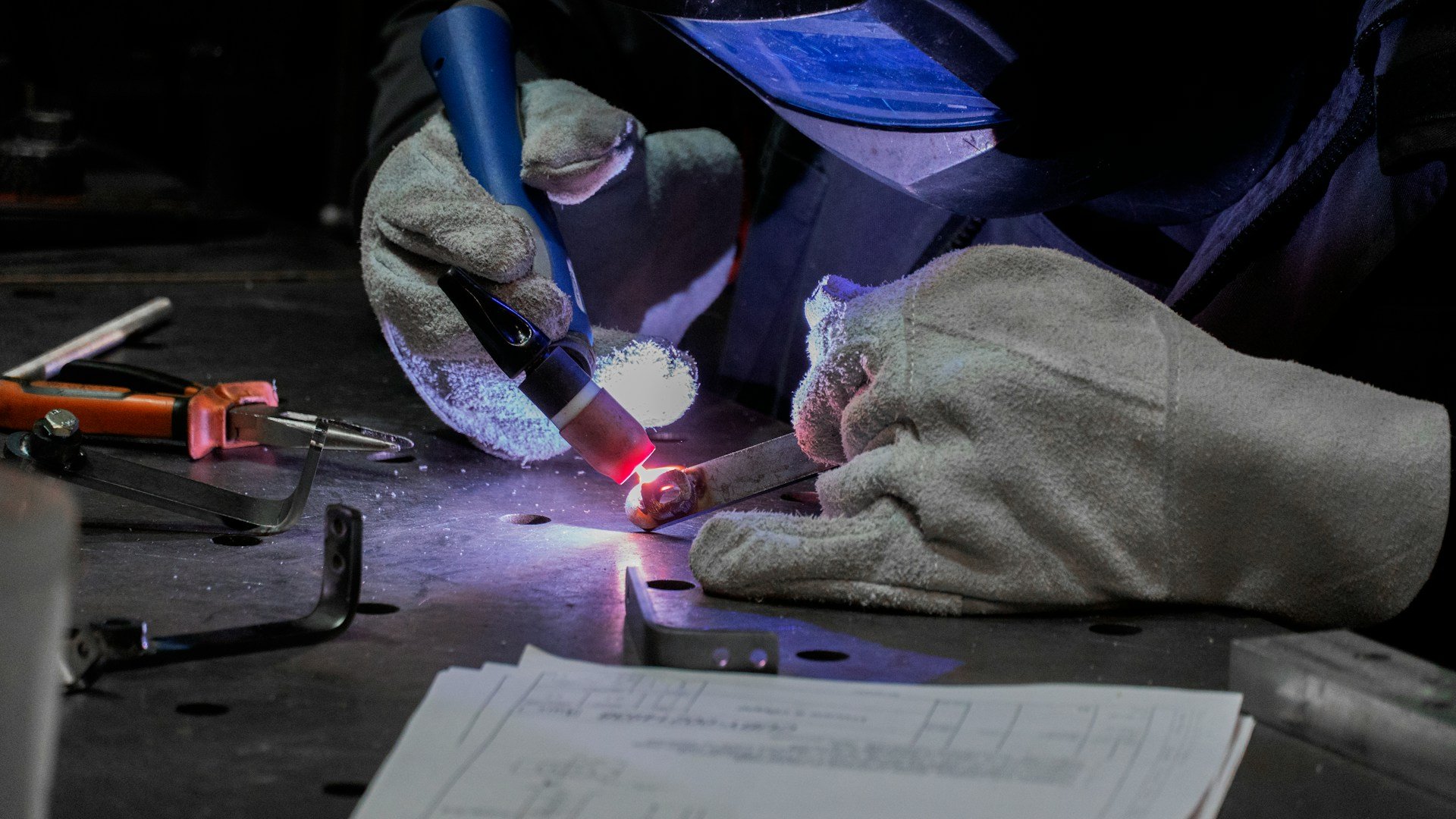
TIG welding uses a tungsten electrode that doesn't melt or get consumed during the weld — it simply creates the arc. The welder holds a torch in one hand and, if filler material is needed, feeds a separate filler rod in with the other hand, dipping it into the weld pool manually.
This hands-on control is exactly what makes TIG both slower and more precise. There's no automatic feed doing part of the job — every movement is deliberate.
Where TIG works well:
Thin-gauge metal that would warp or burn through with MIG
Aluminum, stainless steel, and other non-ferrous metals
Visible welds where appearance matters (railings, food-grade equipment, architectural metalwork)
Applications requiring tight tolerances or minimal heat-affected zones
Because there's less heat input overall, TIG welds tend to show less distortion — which matters a lot on thin material or parts that need to stay dimensionally accurate after welding.
TIG vs MIG: Side-by-Side Comparison
| Factor | MIG Welding | TIG Welding |
|---|---|---|
| Electrode | Consumable wire, continuous feed | Non-consumable tungsten, filler fed by hand |
| Speed | Faster | Slower |
| Learning curve | Easier for beginners | Requires more skill and practice |
| Heat input | Higher | Lower |
| Distortion risk | Higher, especially on thin material | Lower |
| Weld appearance | Good, functional | Cleaner, more refined |
| Best material thickness | Medium to heavy gauge | Thin to medium gauge |
| Common metals | Mild steel, some stainless | Aluminum, stainless, thin steel |
| Typical use case | Structural steel, production runs | Precision parts, visible welds, thin materials |
| Relative cost | Generally lower labor time | Generally higher labor time |
Why the Choice Actually Matters
It's tempting to think welding process is a minor detail that a fabricator can just sort out. In practice, the choice affects three things a project owner cares about directly: cost, timeline, and how the part performs.
1. Heat and Distortion
Every weld introduces heat into the base metal, and that heat has to go somewhere. On thicker steel, it usually isn't a problem. On thin sheet metal or aluminum, too much heat input can cause warping, discoloration, or even burn-through.
This is a common mistake we see before parts arrive for fabrication: a design calls for thin-gauge material but assumes it can be MIG welded the same way as a heavier piece. The result is warped panels that need rework — or worse, parts that don't fit the assembly anymore.
TIG's lower heat input is exactly why it's the go-to choice for thin material and precision components. It's not about TIG being a "better" weld — it's about matching the process to what the material can handle.
2. Speed and Labor Cost
MIG welding is faster because the wire feed is continuous and automated. TIG requires the welder to manually feed filler rod, which slows the process down considerably.
That speed difference shows up directly in labor cost. A part that could be MIG welded in a few minutes might take significantly longer with TIG. For structural components where appearance isn't critical, that added time usually isn't worth it. For precision or visible parts, it often is.
3. Appearance and Finish Requirements
If a weld will be visible on a finished product — think handrails, architectural panels, or equipment with a customer-facing finish — TIG typically produces a cleaner, more consistent bead with less spatter. MIG welds are perfectly strong, but they don't usually have the same refined look without additional grinding or finishing work.
Common Misconceptions
"TIG is always the higher-quality weld." Not necessarily. TIG produces a cleaner-looking weld and better control on thin material, but a properly done MIG weld on structural steel is just as strong for its intended purpose. Quality depends on whether the process matches the application — not which process sounds more advanced.
"MIG can't be used on aluminum or stainless." It can, and often is — particularly on production work where speed matters more than a mirror finish. TIG tends to be preferred on these metals when appearance or thin-gauge precision is the priority, but it's not a hard rule.
"The welding process alone determines the strength of the joint." Joint design, material prep, and weld technique all matter as much as which process is used. A poorly prepared joint will underperform regardless of whether it's MIG or TIG welded.
Design Considerations That Affect the Welding Decision
If you're working with a fabricator on a custom project, a few upfront decisions make it easier for them to pick the right process — and avoid delays later:
Material thickness — Thinner gauges often push a project toward TIG to control heat and distortion.
Material type — Aluminum and stainless commonly favor TIG, especially where corrosion resistance and finish matter.
Visible vs. hidden welds — If the weld will be seen in the final product, flag that early so finish expectations are clear.
Production volume — One-off precision parts and high-volume runs have very different priorities, and that affects process choice.
Tolerance requirements — Tight tolerances on thin material generally point toward TIG's lower heat input.
Sharing this information early — before parts are quoted or scheduled — helps avoid the back-and-forth that causes delays later in a project.
How BSG Approaches the Decision
At BSG, MIG welding is the process we use for the large majority of our fabrication work, simply because it fits most structural steel and general fabrication projects — it's efficient, cost-effective, and produces reliable, strong joints.
That said, we also do TIG welding when a project calls for it — thin material, aluminum components, or parts where a clean, precise weld matters more than speed. Rather than defaulting to one process for every job, we look at the material, the application, and what the part needs to do once it's in service, then match the process accordingly.
If you're not sure which process your project needs, that's a normal part of the conversation — most customers aren't welding specialists, and they shouldn't have to be. A good fabricator will ask about the application and guide the decision from there.
Frequently Asked Questions
Is TIG welding stronger than MIG welding?
Not inherently. Both processes can produce strong, structurally sound welds when done correctly. The right choice depends on the material and application, not which process is "stronger" in general.
Why does TIG welding cost more than MIG?
TIG is slower because filler material is fed by hand rather than automatically. That added labor time is usually the main reason TIG welding costs more per part than MIG.
Can MIG welding be used on aluminum?
Yes, MIG can weld aluminum, and it's common in production settings. TIG is often preferred for aluminum when a cleaner finish or tighter heat control is needed, but MIG remains a valid option depending on the project.
Which welding process is better for thin sheet metal?
TIG is generally better suited to thin sheet metal because it produces less heat input, reducing the risk of warping or burn-through.
Do I need to specify which welding process I want?
Not necessarily. Most customers describe the application, material, and finish requirements, and let the fabricator recommend the appropriate process. It's helpful to mention if the weld will be visible or if the part is thin-gauge material.
How do I know if my project needs TIG or MIG welding?
It depends on material thickness, material type, and whether appearance matters. Thicker structural steel typically works well with MIG. Thin materials, aluminum, or parts with visible welds often call for TIG. A fabricator can advise based on your specific part.